Thursday, July 28, 2011

How Social Media is used in Human Trafficking

          Social Media as defined in Wikipedia, is a term that refers to the use of web-based and mobile technologies to turn communication into interactive dialogue. Andreas Kaplan and Michael Haenlein define social media as "a group of Internet-based applications that build on the ideological and technological foundations of Web 2.0, and that allow the creation and exchange of user-generated content." Social media are media for social interaction, as a superset beyond social communication, but mainly still communicating just interactively using ubiquitously accessible and scalable communication techniques.
          With the latest technologies and internet connection, we can easily communicate with people with just one click. Facebook, Twitter, Skype etc. are just few of the social media that people use today. We can easily interact with others with the use of these services. Now, how is social media involved in human trafficking
         The most popular social-networking site today, as we all know, is Facebook. It can help us connect with our long lost friends and even our relatives who are abroad. Facebook, with all its features, make it easy for us to communicate with our family and friends, even people we just met online or "strangers". Some, without any hesitations, trust these strangers and even have the guts to meet with them without knowing the person thoroughly because they are lured with such benefits and promises offered to them. Traffickers have been known to user Facebook to lure naïve girls into their trap. Teens are normally wary of talking to strangers face to face, but they often let their guard down while on the familiar platform of Facebook. Predators normally pose as music promoters, potential boyfriends or modeling agents. Recently, there have been several news stories in the U.S. where predators were posing as modeling agents in an attempt to lure young girls or obtain lewd photos of them. For example, in Indonesia, Facebook is used as a channel for human trafficking. With a large number of Indonesian users in Facebook, traffickers take this opportunity to exploit their victims and "sell" to their clients. They do this by posting their photos on Facebook, and the clients will select from them and contacts the agent. The culprit of this activity was already arrested and confessed that this activity has been ongoing for two years. As to Andi Primaretha, an Indonesian based in Jakarta, “We’re still fighting the human trafficking in Indonesia. Our country has one of the highest human trafficking issues in Asia." Now, there are a lot of groups formed in Facebook who are fighting against human trafficking.

          On the other hand, social media is also being used to abolish modern - day slavery. It is ironic that the tools used for promoting human trafficking can also be the same tools to abolish it. Through social media, people are being aware of the situation and are being taught how to abolish it. Here are some examples:
  • www.humantrafficking.org _ is a blog to raise awareness about human trafficking. They have conducted the polaris project wherein they seek volunteers to actively maintain and update their social media sites (facebook and twitter) to teach people the realities of human trafficking.
  • human trafficking clinic _ is a site for events related to human trafficking awareness. Last March 31 - April 5 2011, they have conducted 3 events to raise awareness and to combat the problem which includes a benefit concert, art auction and film night.
  • www.notforsalecampaign.org _ is also a blog about human trafficking but what is interesting about it is that this October 21-22, 2011 there will be a global forum on human trafficking joined by Facebook’s Charles Porch and Causes’ Matt Mahan as they share how abolitionists across the globe can use social media in the fight against slavery.

Main Topic: Human Trafficking of Women

          Since around 80% of the total number of victims of human trafficking are women, the group agreed to focus on Human Trafficking of Women. The trafficking of women for sexual exploitation is an international, organized, criminal phenomenon that has grave consequences for the safety, welfare and human rights of its victims. Trafficking in women is a criminal phenomenon that violates basic human rights, and totally destroying victims' lives. Countries are affected in various ways. Some see their young women being lured to leave their home country and ending up in the sex industry abroad. Other countries act mainly as transit countries, while several others receive foreign women who become victims of sexual exploitation.
          According to the International Labour Organization, Forced Labour Statistics Factsheet (2007), 43% of human trafficking victims are used for commercial sexual exploitation, of whom 98% are women and girls and 2.45 million people are estimated to be in conditions of forced labour as a result of trafficking. This number is larger than the population of Namibia. According to The Office to Monitor and Combat Trafficking Persons, 600,000 – 800,000 men, women and children are trafficked across international borders each year. Approximately 80 percent are women and girls. Up to 50 percent are minors. The most common form of human trafficking (80 percent) is sexual exploitation. The victims of sexual exploitation are predominantly women and girls.
          In the Philippines, women are vulnerable to trafficking due to the Asian economic crisis. Requests for entertainer visas for Japan did not decline in the first six months of 1998. Travel to Japan increased 21% in the first half of this year compared with the same period in 1997. The label "entertainer" sometimes implies "sex worker." The women are vulnerable in Japan, not because they lack skills, but because they are young, beautiful women in a hazardous or vulnerable occupation. Approximately 150,000 Filipina women have been trafficked into prostitution in Japan. In 1996, 492 of 3,776 reported cases of child abuse involved pornography, prostitution, paedophilia and trafficking. There were 8,335 cases of child abuse from 1991-1996, 96% of the victims were females. Trafficking laws exists but are not enforced.  Prostitution and sex trafficking are pervasive in the countryside. According to a study made by various non-governmental organizations led by the Women's Education, Development, Productivity and Research Organization (WEDPRO), even remote rural areas are becoming favorite sites for sex traffickers and prostitution syndicates. Certain areas in Laoag, General Santos City, Negros, Southern Tagalog provinces, Pinatubo area, and Pagadian, to name a few, have reported increasing numbers of cases of prostitution, and where prostituted women are no longer from other provinces, but are local women.

Types of Human Trafficking

           Although there is a huge emphasis of human trafficking in having the purpose of sexual exploitation, human trafficking also comes in another type, this is called forced labor. Some of the examples of forced labor includes:
  • being forced to work in massage parlors, strip clubs or other escort services. 
  • being forced into domestic work in private homes, small family business and farms. 
Other types of Human Trafficking includes:
  • Trafficking of Women ("White Slavery") 
                 sex slavery, forced prostitution, sweatshop labor, exploitative domestic servitude
  • Trafficking of Children 
                 for prostitution, pornography, illegal adoption
  • Bonded Labor
       This is referred to in law and policy as "bonded labor" or "debt bondage." Many workers around the world fall victim to debt bondage when they assume an initial debt as part of the terms of employment, or inherent debt in more traditional systems of bonded labor.
  • Involuntary Servitude
                People become victims of involuntary servitude when they believe an attempted escape from their conditions would result in serious physical harm or the use of legal coercion, such as the threat of deportation. Victims are often economic migrants and low-skilled laborers who are trafficked from less developed communities to more prosperous and developed places. Many victims experience physical and verbal abuse, breach of an employment contract, and may perceive themselves to be in captivity—and too often they are.
  • Domestic Servitude
                Domestic workers may be trapped in servitude through the use of force or coercion, such as physical (including sexual) or emotional abuse. Children are particularly vulnerable to domestic servitude which occurs in private homes, and is often unregulated by public authorities.

Human Trafficking: What is it?

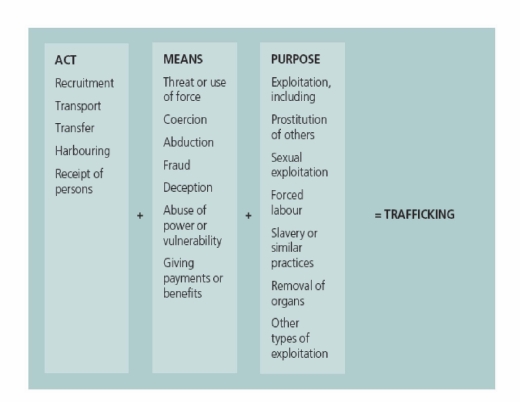
          Human Trafficking also known as the modern-day slavery is defined as the recruitment, transportation, harboring or receipt of persons by means of threat or use of force, abduction, fraud and other forms of coercion for the purpose of exploitation. It is an illegal global criminal activity, it has been identified as the fastest growing criminal industry in the world.
              About 27 million people are enslaved from around the world today and 80% of them are women and children due to their heightened vulnerability caused by gender discrimination, lower rates of education and economic empowerment. According to the UN Office on Drugs and Crime, Trafficking in Persons: Global Patterns, as of 2006, around 161 countries have been affected by human trafficking as receiving, sending and transit destinations. Victims of trafficking can be of any age and gender. However, women are more involved in human trafficking as both victims and culprits. Most trafficking is carried out by people whose nationality is the same as that of their victim.
             Given the definition and statistics of human trafficking, there seems to be three constituent elements; the act, the means and the purpose.
    • The Act
         The recruiting, transporting, transferring and harboring or receipt of people.
    • The Means
         It is done by threatening, forcing or giving payments or benefits to the person in control of  the victim. Coercion, abduction, fraud, deception and abuse of power is also used.
    • The Purpose
         Human Trafficking is done for the purpose of exploitation – exploiting the prostitution of others, sexual exploitation, forced labor or slavery.
    Trafficking in Persons Protocol and the constituent elements of the offense. (UNODC)


    Monday, July 18, 2011

    Use of collaboration tool and report

    The group will conduct a team building for our group collaboration project. To plan for this activity, the group used the online collaboration tool Typewith.me for documents and other planning related activities. These are the features of the collaboration tool that the group used:

    1. Public Document

        We used the public document for formal documents like the schedule of activities, waiver form, expenses and things to bring. These are the ones that we will really look into and will serve as reference for the whole activity.

    2. Chatbox

        We used this to discuss things before we put it in the public document. This is more efficient for us than using only the public document because it tends to cause confusion if members will start to edit some of the things written in the document without asking other group members.

    3. Time Slider

        If in case the public document was edited unexpectedly or the group just want to see the history of typing done in the public document, the time slider allows the group to see everything that has been written, edited or erased in the public document. It does not work for the chatbox, though.

    Here's what the group has to say about these features and the overall online collaboration tool:

       Typewith.me is fairly easy to use and understand. It is very accessible and you do not have to sign up for anything in order to use it. If you would use it for a small online discussion this is one of the practical ways to do so. This is given that our group is only composed of 5 members. We are not sure if this tool will work for a big group.

       But the group encountered one specific difficulty while using typewith.me. some of the members kept being disconnected throughout the discussion so it is a bit annoying to see some of the members disappearing during discussion, that's why we used Skype to continue our conversation since Typewith.me's chat feature kept being disconnected, other than that, the whole discussion went smoothly.